18-11-2025
Digital CommerceFrom AI-native products and enterprise platforms to fintech and blockchain infrastructure, we help organizations design, build and scale technology that drives measurable outcomes.


Entity facts
Why Teams Trust Us With Production Systems
Built With Modern Technologies
Featured Platforms
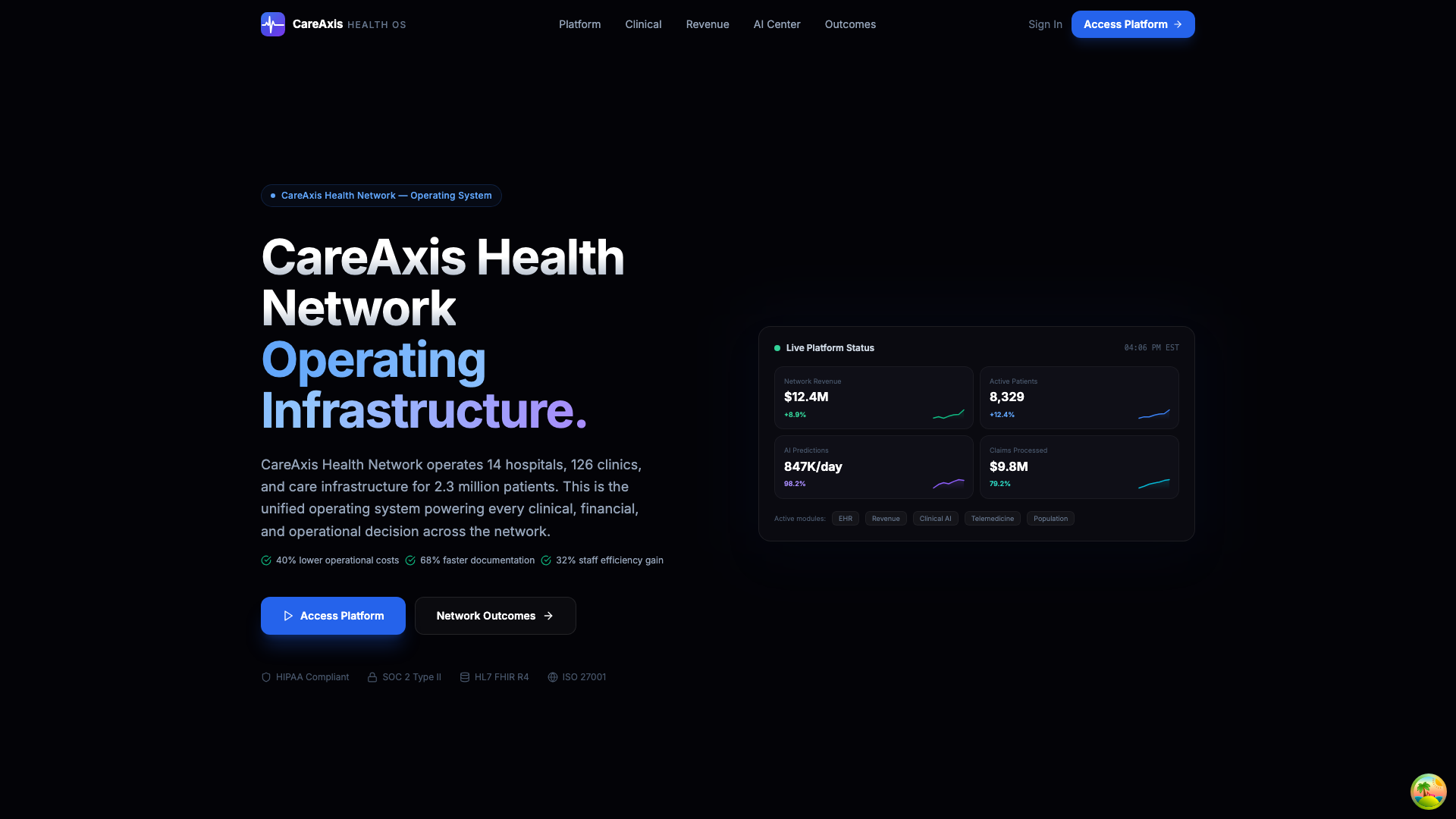
Enterprise healthcare operating system unifying clinical AI, telemedicine, revenue cycle management, and population health — HIPAA-compliant and EHR-integrated.
60%
IT Complexity Reduced
40%
Admin Time Saved
28%
Collections Improved
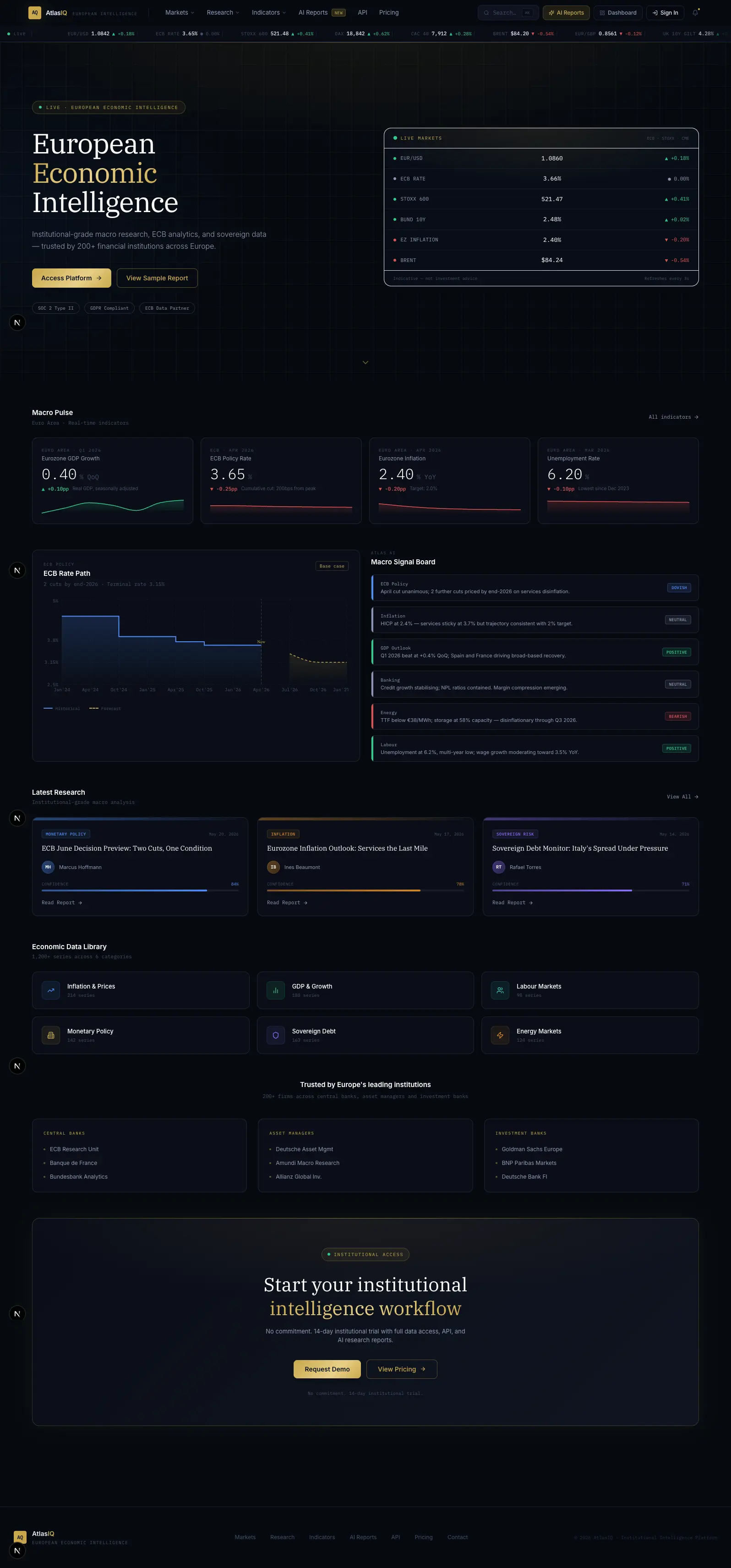
Real-time AI analytics, 40+ intelligence models, and automated decision workflows processing 500M+ data points daily at enterprise scale.
500M+
Data Points/Day
40+
AI Models
99.99%
Uptime SLA
Additional Product Systems
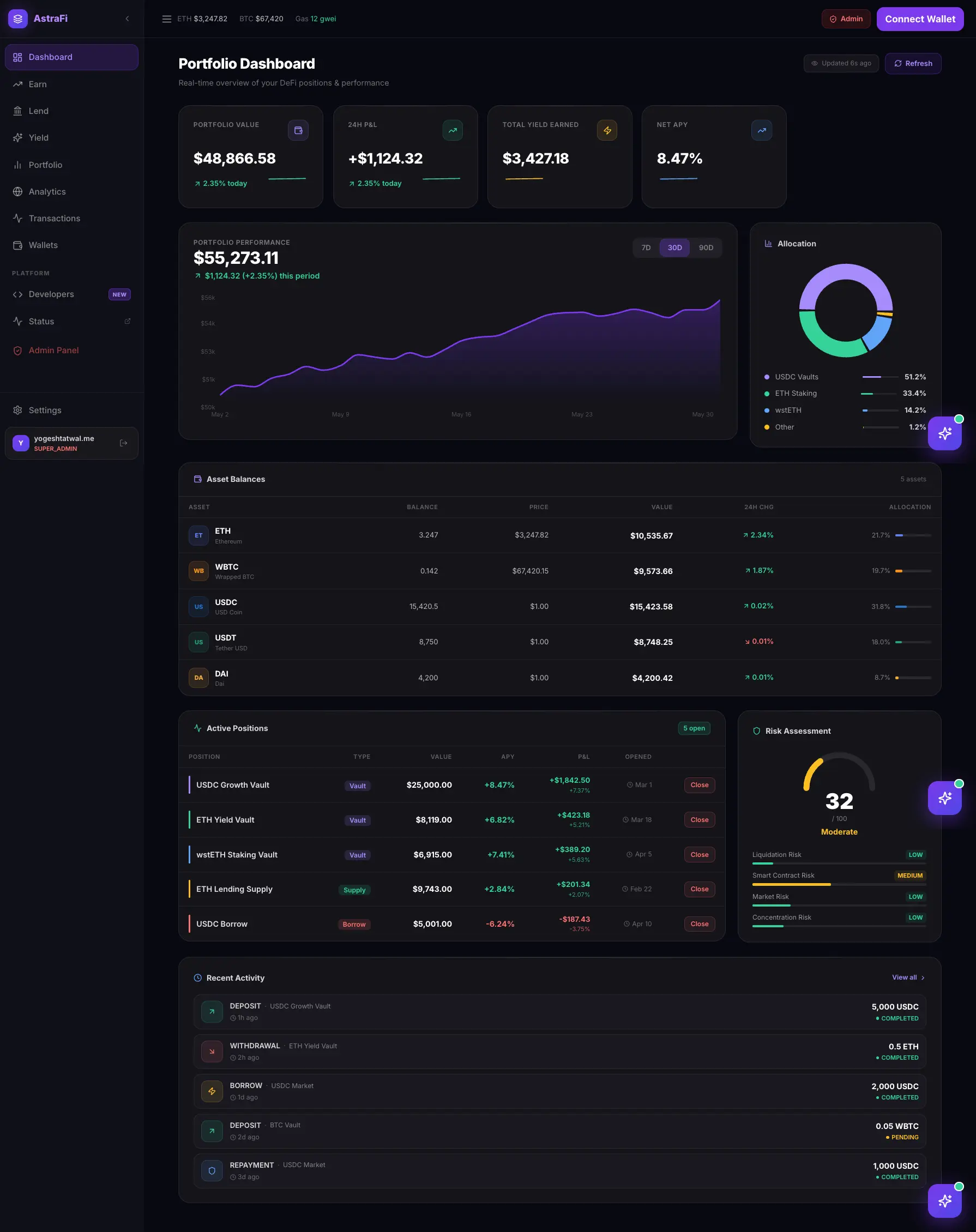
Institutional-grade trading infrastructure, DeFi protocol integration, and smart contract automation. $4.1B simulated TVL, zero settlement failures.
View Platform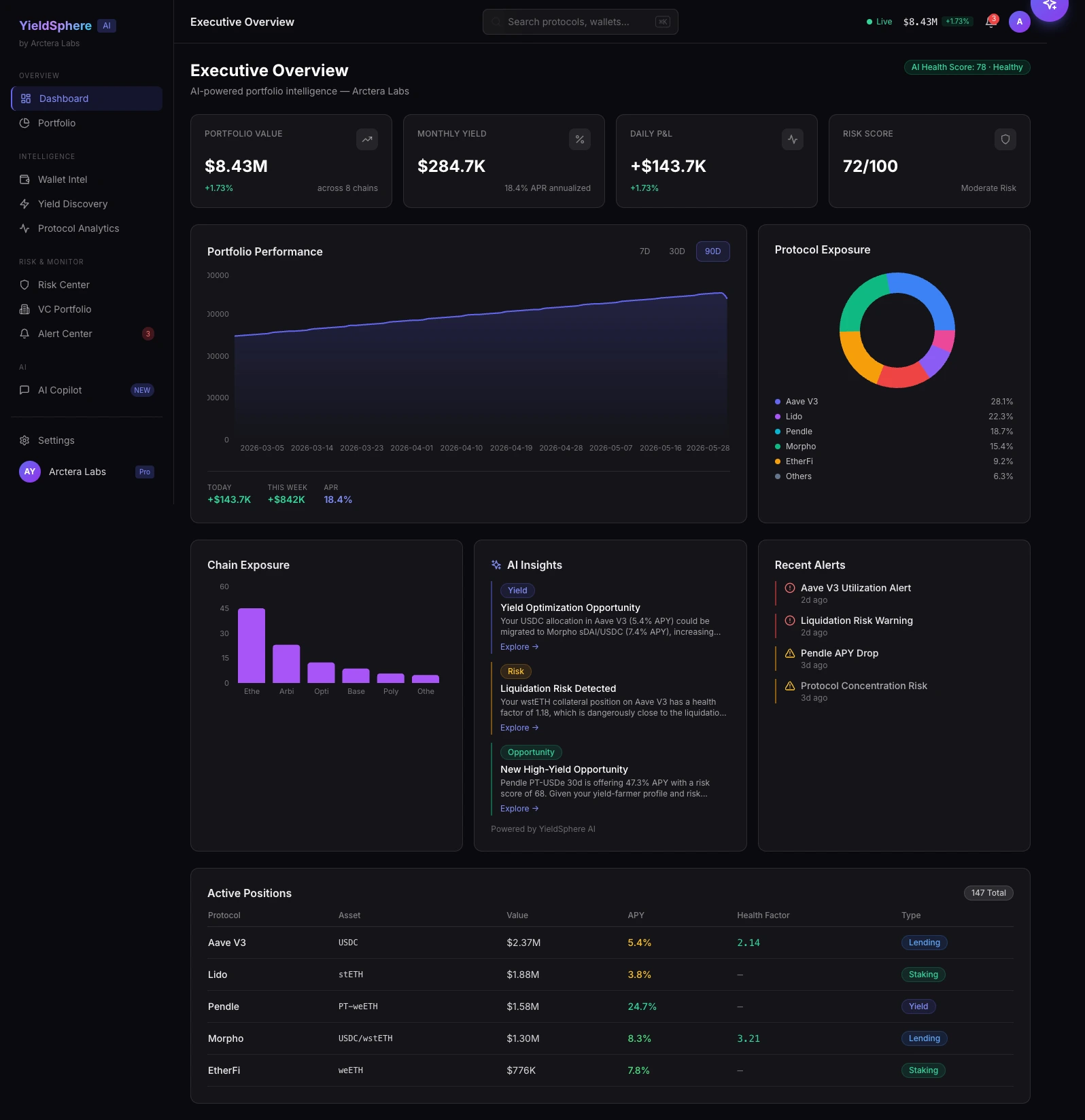
AI-powered capital allocation across 30+ DeFi protocols with real-time risk monitoring. $143M in assets managed.
View Platform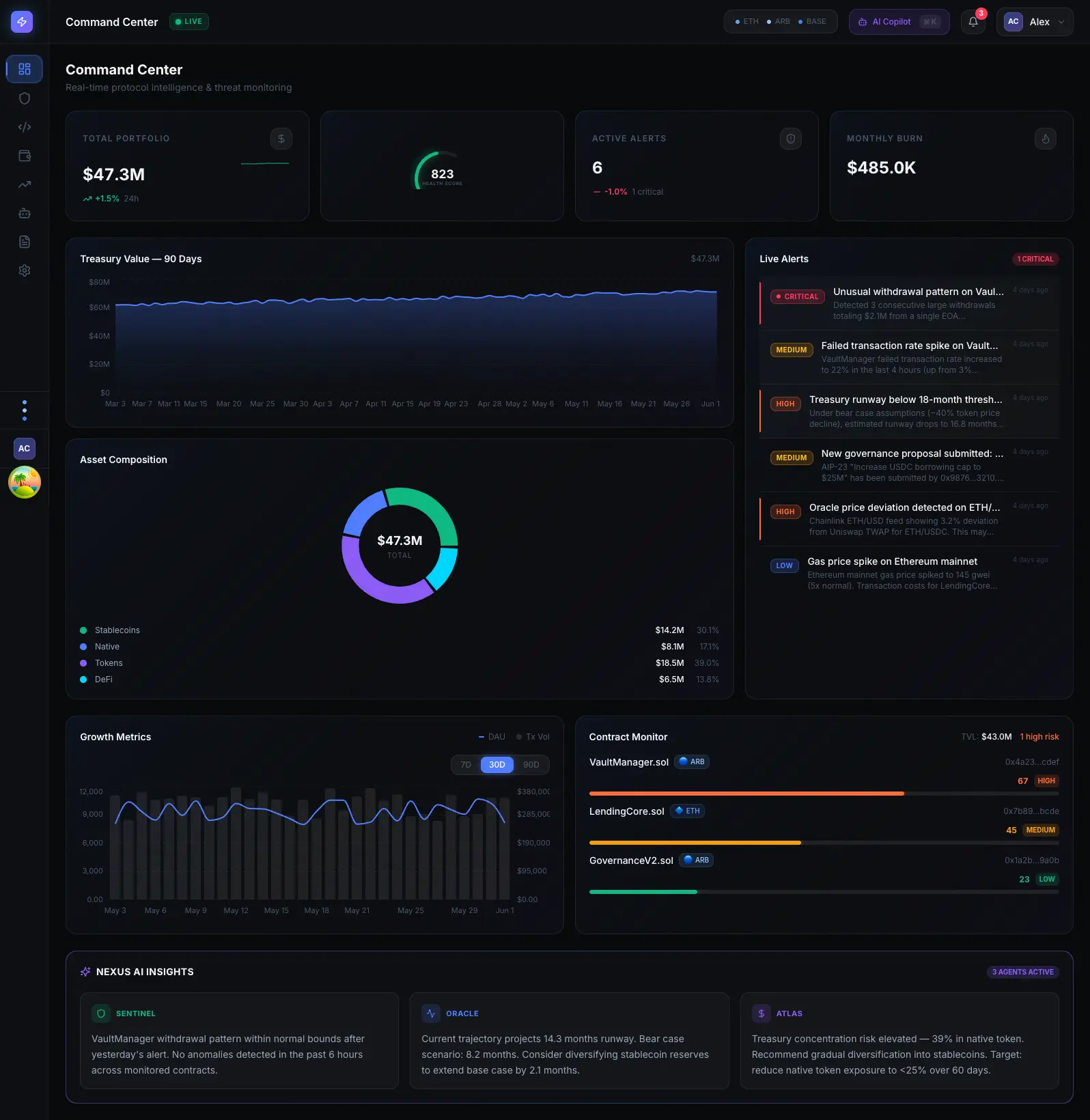
Enterprise AI operating system with multi-agent orchestration, 100+ connectors, and no-code workflow configurability.
View PlatformOur Process
A proven five-phase delivery framework that turns ambitious ideas into production-grade products.
Discovery & Planning
Product discovery, technical architecture, roadmap definition, and competitive positioning.
UX/UI & Architecture
User experience design, system architecture, API contracts, and design system creation.
Build & Integrate
Full-stack development, AI/ML integration, third-party APIs, and automated testing.
Ship & Stabilise
Cloud infrastructure, CI/CD pipelines, security hardening, and production launch.
Optimise & Grow
Performance monitoring, feature velocity, cost optimisation, and long-term partnership.
Services
Four core practices covering the full stack of modern software engineering — from product to AI to infrastructure.
End-to-end product design and engineering — from MVP to enterprise-scale. We own the full technology lifecycle so you can focus on the business.
We build production-grade AI systems — not demos. From intelligent agents to enterprise copilots and LLM-powered data pipelines.
Institutional-grade fintech infrastructure and blockchain applications built for regulatory compliance, security, and global scale.
Cloud-native architecture, DevOps pipelines, and infrastructure automation that give engineering teams the foundation to move fast.
Complete Service Directory
Browse the full breadth of what we build — from architecture strategy to production-grade delivery.
We don't just integrate AI — we engineer production-grade AI systems that become core to how your business operates.
Autonomous multi-step agents that reason, plan, and execute complex business workflows without human intervention.
Context-aware AI assistants embedded directly into enterprise software, supercharging productivity for entire teams.
Retrieval-augmented generation pipelines that connect LLMs to proprietary knowledge bases and real-time data.
AI-powered process automation that eliminates manual work, reduces errors, and scales operations intelligently.
Seamless integration of OpenAI, Anthropic, Google Gemini, and open-source models into existing product stacks.
Intelligent knowledge management systems that surface the right information at the right moment, at enterprise scale.
A selection of enterprise software products and platforms we have designed, engineered, and scaled for real businesses.

A leading sports industry organization needed to bridge the gap between athletes, coaches, agents, and industry professionals. The...
View Case Study
Athletes struggled to effectively market themselves and connect with career opportunities. Traditional methods of networking were ...
View Case Study
A major university faced declining student participation in campus events. The traditional event management approach relied heavil...
View Case Study
A university sought to strengthen campus community bonds and improve student engagement. The existing fragmented approach to campu...
View Case StudyOur Difference
LLM agents, RAG pipelines & fine-tuned models in production
AI is not a feature we bolt on — it's how we architect systems from day one. Every product is designed to leverage intelligence at its core, from data ingestion to decision automation.
Multi-tenant architecture · security-first design
We design for scale from the start. Our systems are built with the resilience, security, and compliance requirements that enterprises demand — not retrofitted after launch.
MVP to production in 8–12 weeks, not 12–18 months
We combine product intuition with engineering precision to move fast without creating technical debt. Bi-weekly demos, CI/CD from day one, and no surprise scope creep.
Architectures proven from 100 to 10M+ concurrent users
Everything we build is designed to grow with you. Kubernetes-native, event-driven, and cloud-agnostic — so your infrastructure never becomes the bottleneck.
Avg. engagement length 18+ months · embedded teams
We don't hand off and disappear. We stay embedded as a strategic engineering partner — aligning with your roadmap, not just a single sprint or statement of work.
Embedded engineers in your tools & cadence
You work directly with the engineers and tech leads on your project — in your tools, your sprint cadence, and your communication channels. No account-manager layer between you and the people writing the code.
Halkwinds Research
Every engineering organization now tracks some form of productivity metric, and nearly all of them are experimenting with AI-assisted development — yet the relationship between AI adoption, developer experience, and actual delivery performance is far messier than headline productivity claims suggest. This report benchmarks DORA and SPACE metrics, AI coding assistant ROI, developer experience investment, and enterprise delivery performance across 758 engineering organizations, and maps what separates teams that convert AI tooling into measurable throughput from teams that convert it into more code review debt.
Read reportEnterprise AI has crossed the operational threshold. Seventy-two percent of Fortune 500 organizations now run at least one AI system in production — and the average enterprise manages 3.4 concurrent AI initiatives. This report maps the state of enterprise AI across healthcare, manufacturing, financial services, retail, and beyond.
Read reportAdvanced manufacturing is undergoing a fundamental transformation as artificial intelligence, real-time sensor fusion, and materials informatics converge to redefine what is possible on the production floor. Traditional manufacturing process control relied on human expertise accumulated over decades, periodic quality inspections, and reactive maintenance schedules. Today, manufacturers are deploying AI-driven systems that continuously optimize cutting parameters, thermal cycles, and material flows in real time, compressing the distance between process deviation and corrective action to near-zero latency. CNC modernization stands at the forefront of this shift. Older computer numerical control systems operated with fixed toolpaths and static feed-rate tables; next-generation adaptive controllers ingest spindle load telemetry, vibration signatures, and thermal imaging to dynamically adjust cutting conditions mid-operation. The result is a tighter feedback loop that extends tool life, reduces scrap, and allows operators to confidently run lights-out shifts. Semiconductor and electronics manufacturing occupy a special position in this landscape because their tolerance windows are measured in nanometers and angstroms. Any process drift that would be acceptable in heavy industry is catastrophic in wafer fabrication or PCB assembly. AI inference engines trained on vast libraries of process data are being embedded directly into deposition tools, etchers, and surface-mount lines to catch drift before it propagates to yield loss. Materials informatics adds another dimension by accelerating alloy design, polymer formulation, and composite layup optimization. Rather than relying on trial-and-error laboratory campaigns, engineers now use machine learning models trained on crystallographic databases and prior experimental records to narrow the search space for new formulations. This drastically shortens the time from material concept to validated production-ready specification. This report examines each of these threads in depth, exploring the technology landscape, enterprise adoption dynamics, implementation challenges, and strategic pathways for manufacturers seeking to capture value from advanced process innovation.
Read reportManufacturing is undergoing a fundamental shift in how it identifies, develops, and retains skilled workers. The convergence of immersive technologies, intelligent scheduling systems, and collaborative robotics is rewriting the relationship between human capability and operational performance on the factory floor. This report examines how enterprise manufacturers are deploying AR/VR platforms to compress training timelines and standardize knowledge transfer, while connected worker systems create real-time visibility into workforce utilization, fatigue, and compliance. Skills gap analytics are moving from reactive headcount planning to predictive talent development, enabling operations leaders to anticipate capability shortfalls before they affect throughput. AI-driven workforce scheduling is reducing idle time and overtime while aligning human capacity with dynamic production demands. Meanwhile, the rapid deployment of collaborative robots — cobots — is requiring new frameworks for human-machine teaming, task hand-off protocols, and ergonomic co-design. The implications extend beyond efficiency: manufacturers who invest in workforce technology are building adaptive organizations capable of absorbing disruption without retraining entire workforces from scratch. Yet adoption is uneven. Large-scale discrete manufacturers have moved earliest, while process industries and SME suppliers continue to navigate the cost and change-management barriers. The technology landscape itself is fragmented: standalone AR headset vendors, workforce management suites, LMS platforms, and cobot integrators all claim to solve adjacent problems without offering an integrated view of workforce readiness. This report synthesizes practitioner experience, technology capability, and strategic implementation patterns to give manufacturing leaders a structured framework for evaluating, sequencing, and deploying workforce technology investments that compound over time.
Read reportQuality management systems have undergone a fundamental transformation over the past decade. What once resided in binders, spreadsheets, and siloed document repositories now lives inside integrated enterprise platforms that connect inspection data, supplier records, corrective actions, and compliance documentation into a single operational fabric. The shift from document-based QMS to enterprise QMS—and now to AI-augmented quality platforms—reflects not merely a technology upgrade but a rethinking of what quality means in modern manufacturing: less an end-of-line gate and more a continuous, data-driven discipline woven into every production step. For organizations navigating ISO 9001 or IATF 16949 compliance, the stakes of this transition are high. Legacy approaches to quality often depend on manual data collection, periodic audits, and reactive corrective action processes that surface problems only after defects have propagated through the value chain. Modern EQMS platforms and AI-assisted inspection systems shift that posture—enabling statistical process control at machine-level granularity, near-real-time nonconformance tracking, and predictive quality signals derived from sensor and production data. Practitioners report that the path to effective quality modernization is rarely straightforward. Integrating EQMS with ERP, MES, and supplier portals requires careful architectural planning, data governance discipline, and change management investment that technology vendors often underestimate in their sales cycles. Organizations that approach quality platform deployments as pure software implementations—without addressing the underlying process maturity gaps—typically see limited return. This report examines the enterprise QMS technology landscape as it stands in 2026: the platforms shaping the market, the AI capabilities moving from pilot to production, the compliance technology requirements driving adoption, and the implementation patterns that separate successful deployments from costly false starts. It is written for quality leaders, operations directors, and enterprise architects who need a clear-eyed view of where the technology is and where it is heading.
Read reportManufacturing is undergoing a fundamental shift as collaborative robots, autonomous mobile robots, and robotics-as-a-service models reshape the economics of automation. Unlike the industrial robots of earlier decades — heavy, caged, and programmed only by specialists — today's cobots work beside human operators, adjust to changing tasks through intuitive teach-pendant or hand-guided programming, and can be deployed in days rather than months. This transition is particularly significant for small and medium-sized manufacturers who previously lacked the capital and engineering depth to compete with highly automated large-scale producers. This report examines the current state of robotic deployment across discrete manufacturing, logistics, and process industries. It explores how cobot adoption patterns differ from traditional industrial automation, what autonomous mobile robots contribute to intralogistics efficiency, and how the emerging robotics-as-a-service model is changing the ROI calculus for manufacturers of all sizes. It also addresses the workforce dimension honestly: which tasks are being automated, what new skills workers need, and how leading manufacturers are managing the transition collaboratively rather than adversarially. The implementation section draws on deployment experience across automotive tier suppliers, electronics assembly, food and beverage, and precision machining — offering a grounded view of integration complexity, safety certification, and the hidden costs that routinely surprise first-time adopters. The report concludes with strategic recommendations for manufacturers at each stage of the automation journey, from initial feasibility assessment through fleet-scale deployment and continuous improvement programs powered by robot-generated operational data. Readers will come away with a clear framework for evaluating cobot and AMR candidates within their own operations, a realistic picture of payback timelines across different deployment scenarios, and a set of organisational and cultural practices that distinguish manufacturers who realise sustained gains from those whose automation investments underperform.
Read reportResearch & Insights
Original research, benchmarks, industry analysis, and implementation insights from the teams building AI systems and enterprise software every day.
Primary research from 847 enterprise technology leaders across 34 countries. State of production AI, agent architectures, GenAI TCO, RAG adoption, and a five-industry breakdown with investment data and 2028 outlook.
Explore expert articles, case studies, and industry insights to help your business grow smarter.